
Framingham homeowners, condo owners and landlords looking for hardwood floor refinishing can request a free quote from Boston Hardwood Refinishing. Framingham’s housing is mostly mid-century: ranches, capes, split-levels and colonials across Saxonville, Nobscot and Pinefield, older homes around Framingham Centre and downtown, and condo and apartment complexes along Route 9 and near the Golden Triangle. Many of these houses still have their original oak, sometimes hidden under carpet, and the right plan depends on the floor, the layout and your calendar.
Prefer to talk it through? Call (857) 837-1234.
Why Framingham homeowners refinish
Common reasons: pulling up old wall-to-wall carpet and finding oak underneath, getting a house ready to list, updating a home bought from its original owners, worn finish in kitchens, halls and entries, and pet scratches in busy family homes. Not every floor needs bare-wood sanding. If the finish is still intact and only dull or lightly scratched, start with the recoat vs refinish guide. Wear into the wood, gray spots or a change of stain color usually mean full refinishing.
Homes in Framingham
Framingham grew fast in the decades after World War II, so much of the city is ranches, capes, split-levels and garrison colonials on quiet side streets. Closer to Framingham Centre and downtown you’ll find older colonials, Victorians and multi-family houses, and along Route 9 and the Golden Triangle there are condo and apartment communities. Each type changes how a refinish is planned: open floor runs, short stair sections and association rules matter as much as the wood.
- Ranches & capes
- Split-levels & raised ranches
- Garrison & center-entrance colonials
- Older homes near downtown
- Condos & townhouses
Framingham housing age by the numbers
According to the U.S. Census Bureau’s American Community Survey (2020–2024 5-year estimates), Framingham has about 27,918 housing units. Roughly 17% were built in 1939 or earlier and about 40% before 1960.
Only about one in six Framingham homes predates 1940; most were built after 1950. That matches what homeowners usually find: mid-century solid oak strip, often hidden under carpet, rather than old-growth softwood.
Source: U.S. Census Bureau, ACS 5-year estimates, table B25034 (Year Structure Built), via Census Reporter and data.census.gov. Figures are estimates with margins of error. Lead-safe work rules for homes built before 1978: EPA RRP program.
Floors common in Framingham homes
- Oak strip under carpet. Many mid-century ranches, capes and split-levels were built with solid oak strip in the living room, hall and bedrooms, then covered with carpet. Once the carpet, pad and tack strips are gone, this floor often refinishes well, though staples, pad stains and pet spots are common and worth photographing.
- Older oak, fir or pine in houses near Framingham Centre and downtown. Softwood dents easily and can blotch with stain; see the guide to refinishing old fir and pine floors.
- Mixed or patched floors where a kitchen was opened up, a wall came out or an addition was built. New boards woven into old oak need to be scoped so the color blends after sanding.
- Engineered hardwood in newer condos, townhouses and renovated lower levels. Some can be sanded once or twice; thin wear layers may only take a screen & recoat.
- Short stair runs in split-levels and raised ranches, often carpeted or worn in the center of each tread. They can be done with the floors; see stair refinishing.
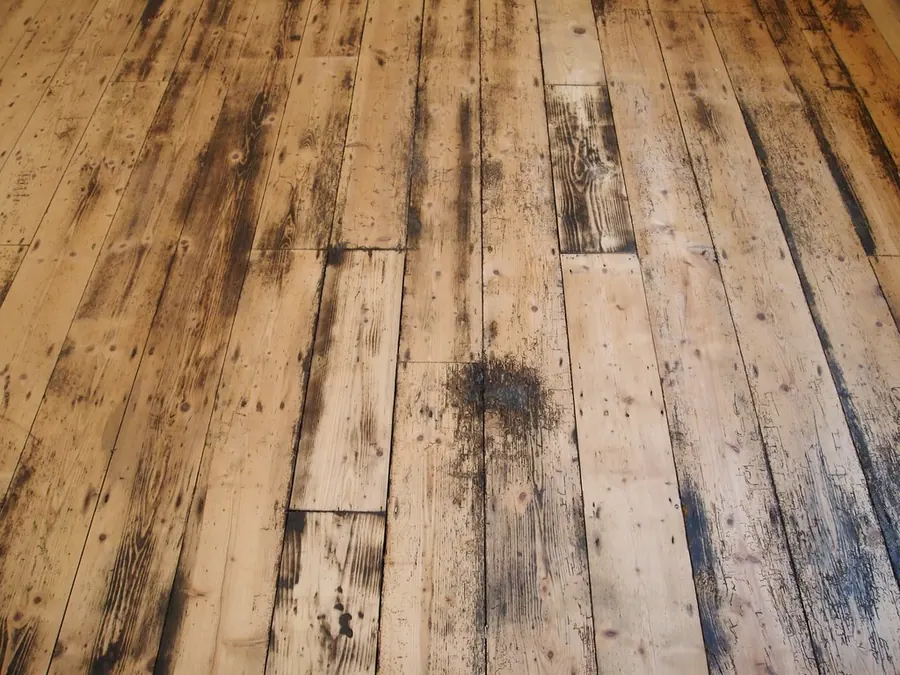
Found hardwood under the carpet? What to check first
This is one of the most common Framingham questions. Before you plan a refinish, lift a corner of carpet in a closet or along a wall and look at what’s underneath. A few things change the plan:
- Does the wood run under the walls? Solid oak usually runs continuously from room to room. If it stops at a doorway or a patch of plywood shows up, mention it.
- Staples, tack strips and pad residue. These come out as part of prep, but the holes along the walls and any glued pad residue should be in the photos you send.
- Dark stains and pet spots. Light surface marks often sand out. Deep black stains from pet urine or water may not, and those boards might need replacing.
- Thickness. Solid strip flooring has a lot of sanding life. If you can see the edge of a board at a heating vent or threshold, a photo helps confirm how much wood is left above the tongue.
Leave the carpet in place if you’re not sure yet. It protects the floor until the work starts, and a photo of one lifted corner is enough to begin the conversation. For a fuller Greater Boston checklist (asbestos under old vinyl, pet stains, recoat vs refinish after uncovering), see the hardwood under carpet guide.
Framingham neighborhood notes for floors
From the old mill village on the Sudbury River to the condo complexes along Route 9, the floors change with each part of Framingham:
- Saxonville: the nineteenth-century mill village around Central, Elm and Danforth Streets, with side-by-side double houses and older single-families close to the river. Floors here can be original softwood or early oak with generations of patches, and one side of a double house may have been renovated very differently from the other.
- Pinefield and North Framingham: post-war streets of ranches, capes and split-levels around the Pinefield shopping area and across the north side. Oak strip under old carpet and short half-flights between levels are the usual finds.
- Nobscot: larger lots on the north side with colonials, split-levels and raised ranches. Open main floors are normally sanded as one area to keep the color even.
- Framingham Centre: the area around the historic Centre Common, where many of Framingham’s earliest houses stand near churches, the old academy and mid-century homes. Older houses may have wide boards upstairs and narrower oak put down later on the main floor.
- Downtown and South Framingham: two- and three-family houses, older single-families and apartment buildings close to the commuter rail. Rentals, shared stairs and old vinyl or carpet over the boards are common.
- Route 9 and the Golden Triangle: condo, townhouse and apartment communities near the shopping and office areas, where association work hours, assigned parking and shared walls drive the schedule. Many units have engineered or prefinished flooring.
Floors in Saxonville’s mill-village houses
Saxonville grew up around a woolen and later carpet-yarn mill on the Sudbury River. The National Register nomination for the Saxonville Historic District (listed 1992) traces the mill complex to 1823, notes that worker housing built by the mill owners between 1823 and 1887 makes up over half of the houses in the district, and records that the mill-owned houses were sold at auction in 1938. Carpet was made at the mill until the Roxbury Carpet Company closed in 1973.
That history shows up in the floors. Each half of an old double house may have its own mix of original boards, later oak and patches. Expect a few things here:
- Softwood in older rooms. Pine or fir boards are softer than oak and dent easily, so they are sanded more gently and can blotch with stain. See the guide to old fir and pine floors for how that changes the job.
- Floors that are not level. Old framing settles. Sanding smooths the surface but will not remove a slope, and chasing flat wastes wood.
- Paint on old wood. Painted border strips, thresholds, stair risers and back stairs in pre-1978 houses need a lead test before sanding or scraping, and paid work follows the EPA RRP rules.
Mid-century ranch and split-level details
In Framingham’s post-war houses, a few details decide how the job is laid out:
- Where the oak stops. In many ranches the oak stops at the kitchen, which has sheet vinyl or tile instead. Older sheet goods, 9-inch tiles and their adhesive can contain asbestos, so have them tested before anyone pulls them up to extend the wood.
- Floor registers and returns. Floor registers come out for sanding and go back after the finish dries; mention any that are loose or rusted.
- Lower levels. A split-level or raised-ranch family room is often on a slab or partly below grade, where solid hardwood is rare, so it is usually left out of the sanding.
Planning around a split-level or open main floor
In a ranch or split-level, the living room, dining area and hall usually share one continuous floor. Refinishing it all at once gives the most even color and avoids visible lines at doorways, but it means clearing the whole level and staying off it while the finish dries. Bedrooms down the hall can sometimes be done in the same pass. Note whether you can move furniture to another level, a garage or a basement, and whether you need a path kept open to the kitchen or the bedrooms. Split-levels with a half-flight to the upper bedrooms often need the stairs and upper hall sequenced so nobody gets stuck on the wrong side of wet finish.
Condos and townhouses in Framingham
For a condo or townhouse, check your association documents for rules about work hours, parking for work vehicles, notice to neighbors and certificates of insurance, and include them in your quote notes. Many newer units have engineered flooring, so say what you know about the product.
Condos near the downtown commuter rail station are often in converted houses or older buildings with no elevator, so all equipment goes up a shared stair; tell the other owners which days it will be busy and check where a work vehicle can park. Larger complexes along Route 9 usually want advance notice through the management office and may limit machine work to set weekday hours. If you commute, say how the door will be opened during the day: key, lockbox or management.
Rentals and listing dates in Framingham
Between tenants. In the two- and three-family houses around downtown and South Framingham, the gap between leases is usually the only chance to sand a unit. Schedule the floors once the painter and any repair work are done and before the final clean, leaving room for curing ahead of the next tenant’s furniture. Include both lease dates and whether anyone will still be living there. The Massachusetts Lead Law makes owners of homes built before 1978 responsible for lead paint hazards where a child under six lives, and that covers owners living in their own single-family house as well as landlords. Refinishing the floors does not count as deleading.
Before listing. Many Framingham sellers uncover the oak under old carpet right before a sale. The usual order is paint, then floors, then cure time before staging furniture and listing photos. Light wear with the finish still intact may only call for a screen and recoat, which is faster. The guide to refinishing floors before selling covers timing the floors around repairs, painting and listing photos. Separately, sellers and agents of pre-1978 homes owe prospective buyers the state’s Property Transfer Lead Paint Notification before the P&S is signed, and new floors have no bearing on that duty.
Local logistics to mention on your quote
- Carpet over hardwood: say whether carpet is still down, and send a photo of a lifted corner if you can.
- Whole level vs. room by room: note whether an entire floor can be cleared at once and where furniture can go.
- Stairs: mention split-level half-flights or a main staircase. They’re usually scoped separately.
- Driveway & access: note the driveway or parking situation, or condo parking rules.
- Pets & kids: mention them so the plan covers noisy sanding days and dry-time days.
- Old flooring or paint: mention old vinyl or asphalt tile, adhesive, or painted borders. In older homes these can contain asbestos or lead paint and should be tested before sanding or scraping.
- Timing: include any move-in, listing or holiday date you’re working toward.
Framingham’s local historic districts and interior floors
According to the City’s Historic District Commission page, Framingham created its first local historic district around the Framingham Centre Common at the 1978 Annual Town Meeting under Chapter 40C, and has expanded it since, most recently in 2023. The other local districts are the Jonathan Maynard Historic District and several single-property districts, among them the H.H. Richardson Depot. The same page says the Commission has purview over changes to the exterior of a designated building that are visible from a public way, and that regular maintenance keeping an element’s design, materials and finish does not need a certificate.
Refinishing floors inside a house in one of these districts happens out of sight of the street, which places it beyond that exterior review. Porch floors, front steps or doors replaced in the same project are another matter; the City’s preservation staff in Planning and Community Development can say whether that part needs a Certificate of Appropriateness. Saxonville, although listed on the National Register, does not appear among the local historic districts on the City’s page, and condo association rules still apply wherever you live.
Services available in Framingham
- Full hardwood refinishing: sand to bare wood, optional stain, new finish
- Floor sanding with dust-controlled options (not zero dust)
- Stair refinishing: treads, risers, nosings and landings
- Help choosing screen & recoat vs full refinish
Process & dust expectations
Prep → sand → optional stain → finish coats → cure. Sanding days are noisy; dust-controlled equipment helps but is not zero dust. Full walkthrough, including whether you can stay home during the work: process & timeline and floor sanding. Common questions are answered in the FAQ.
What to prepare for a quote
To plan a Framingham job, it helps to know the neighborhood or street and the type of home, such as a ranch, split-level or colonial, one side of a Saxonville double house, a unit in a downtown two-family, or a condo off Route 9. List the rooms and stairs, say whether carpet, vinyl or tile still covers any of the wood, and mention painted boards, floor registers or a wall that was taken out. For a condo, add the association’s work hours and parking rules; for a rental or sale, add the lease dates or the listing photo date. Finish with your preferred phone number or email. Once the request is in, reply to the confirmation email with a wide shot of each room from the doorway, a lifted corner of any carpet, close-ups of stains or worn spots, and the stairs from the bottom.
Nearby areas served
Also covering Waltham, Newton, Boston, Brookline, Cambridge, Somerville and Quincy. Newer service-area pages: Arlington, Medford, Watertown, Belmont and Needham. Full list: service areas.
Or call (857) 837-1234.
Frequently asked questions
Which Framingham neighborhoods are covered?
Framingham neighborhoods including Saxonville, Nobscot, North Framingham, Pinefield, South Framingham, Framingham Centre, downtown and the Route 9 / Golden Triangle area.
I found oak under my carpet. Can it be refinished?
Usually, yes. Solid oak strip from mid-century homes often has plenty of sanding life. Staple holes, pad residue and light stains are normal; deep black pet or water stains may mean replacing a few boards. Send a photo of a lifted corner with your quote request.
Should I refinish the whole main floor at once?
If the living room, dining area and hall share one continuous floor, doing them together gives the most even color and no lines at doorways. Note whether the whole level can be cleared and where furniture can go.
Can you do just the stairs in a split-level?
Often, yes. Describe the stairs on the quote form and say whether they’re carpeted or bare wood. See stair refinishing for what’s involved.
Can engineered floors in a Framingham condo be refinished?
Sometimes. It depends on the thickness of the top wear layer. Mention “engineered” in your notes and, if possible, send a photo of a board edge at a threshold or vent.
Does Framingham’s Historic District Commission review floor refinishing inside a house?
No. The City’s Historic District Commission page describes its purview as exterior changes to designated buildings that are visible from a public way, so sanding and refinishing interior floors is outside it. If porch floors, front steps or doors are part of the same project, ask the City’s preservation staff before that work starts.
Are floors in an old Saxonville mill house refinished differently from a ranch?
Often, yes. Older mill-village houses can have softwood boards, settled framing and patches from many owners, so sanding is gentler and the floor is not forced flat. Post-war ranches usually have uniform oak strip under carpet that sands more predictably. Painted wood in either should be lead tested first.
Photos are licensed stock and Creative Commons images used as examples. Photo credits