
Boston Hardwood Refinishing provides hardwood floor refinishing, floor sanding, screen and recoat work and stair refinishing in thirteen Greater Boston communities: Boston, Cambridge, Somerville, Brookline, Newton, Waltham, Quincy, Framingham, Arlington, Medford, Watertown, Belmont and Needham. Pick your city below for local notes on housing, the floors you’re likely to find and what to mention on a quote, or start a free quote with your ZIP code.
Prefer to talk it through? Call (857) 837-1234.
Choose your city
Each city page covers neighborhoods, common floor types, condo and rental planning, and local FAQs. Where a housing-age tag is shown, it uses the Census figures in the original eight-community comparison below. The five additional town pages focus on project decisions and locally sourced preservation resources; no housing-age statistics are assumed for them.
- 47% built before 1940
Boston
Brownstone and row-house condos in Back Bay, Beacon Hill and the South End, triple-deckers in Dorchester and Jamaica Plain, and single-family streets in West Roxbury. Many floors have been sanded before, and building rules often set the schedule.
Floor refinishing in Boston - 47% built before 1940
Cambridge
Triple-deckers and worker cottages with original Douglas fir or pine sit next to newer apartment and condo buildings, so a Cambridge job can be century-old softwood or an engineered floor.
Floor refinishing in Cambridge - 59% built before 1940
Somerville
The largest pre-1940 share in the eight-community Census comparison, mostly two- and three-family homes. Expect softwood or oak in stacked units, shared stairs, and floors hidden under carpet or vinyl.
Floor refinishing in Somerville - 52% built before 1940
Brookline
Pre-war apartment and condo buildings plus larger single-family houses. Oak parquet, herringbone and narrow strip oak are common, and association rules shape timing.
Floor refinishing in Brookline - 49% built before 1940
Newton
Newton’s villages are mostly single-family colonials, Victorians and mid-century homes. Solid red and white oak strip is typical, often under carpet, and additions sometimes don’t match the original floor.
Floor refinishing in Newton - 28% built before 1940
Waltham
Mill-era multi-families near Moody Street and the Charles, post-war single-families and riverfront condos. Refinishing between tenants is one of the most common requests.
Floor refinishing in Waltham - 37% built before 1940
Quincy
Older two-families and colonials alongside many post-war and newer condos, including waterfront buildings. Solid oak and engineered floors are both common, and coastal humidity affects gaps and dry time.
Floor refinishing in Quincy - 17% built before 1940
Framingham
The newest housing in the eight-community Census comparison: about 60% of homes were built in 1960 or later. Mid-century oak strip under carpet and split-level stairs are what homeowners usually find.
Floor refinishing in Framingham - Project planning
Arlington
Preserving existing boards, checking thin edges and separating indoor floor work from historic-district exterior changes.
Floor refinishing in Arlington - Project planning
Medford
Occupied-unit scheduling, common stairs, leak checks and the difference between Medford’s local and national historic designations.
Floor refinishing in Medford - Project planning
Watertown
Engineered-versus-solid identification, factory-finish adhesion testing and condo approval questions before sanding.
Floor refinishing in Watertown - Project planning
Belmont
Connected-room boundaries, realistic matching to retained floors, repair patches and stair access planning.
Floor refinishing in Belmont - Project planning
Needham
Renovation sequencing, new-to-old floor transitions and cure-time planning before furniture delivery or staging.
Floor refinishing in Needham
Housing age in the original eight communities
The age of a home is one of the most useful early clues to what’s under your feet and how many times it may already have been sanded. Here is how the original eight communities compare, using the same Census figures shown on each city page (“Homes” means total housing units; “pre-1940” means built in 1939 or earlier).
| City | Homes | Built pre-1940 | Built pre-1960 |
|---|---|---|---|
| Boston | 310,625 | 47% | 58% |
| Newton | 33,959 | 49% | 67% |
| Brookline | 28,873 | 52% | 65% |
| Cambridge | 54,840 | 47% | 54% |
| Somerville | 37,756 | 59% | 69% |
| Quincy | 48,072 | 37% | 52% |
| Framingham | 27,918 | 17% | 40% |
| Waltham | 26,728 | 28% | 49% |
Within this eight-community comparison, Somerville and Brookline have the largest share of pre-1940 homes, while Framingham and Waltham lean toward post-war and later construction. Newton stands out for its high share of homes built before 1960. These are citywide estimates; a single street or building can be very different, so photos of your floor always matter more than the table.
Source: U.S. Census Bureau, American Community Survey 2020–2024 5-year estimates, table B25034 (Year Structure Built), via Census Reporter and data.census.gov. Figures are estimates with margins of error.
How floors differ across Greater Boston
- Pre-1940 city housing (much of Somerville, Cambridge, Brookline and older Boston neighborhoods): two- and three-family homes and early apartment buildings often have Douglas fir or yellow pine in kitchens, back halls and upper units, with oak in front rooms. Softwood dents easily and can take stain unevenly, so it needs its own plan; see refinishing old fir and pine floors.
- Pre-war condo buildings (Brookline, Back Bay, the South End): oak parquet, herringbone and narrow strip oak, sometimes with borders. These floors may have been sanded several times, so remaining thickness is worth checking before a full sanding.
- Mid-century suburbs (Framingham, Waltham, much of Newton and Quincy): solid oak strip, frequently found when wall-to-wall carpet comes up. It usually refinishes well once staples, tack strips and pad residue are dealt with; see full hardwood refinishing.
- Newer condos and additions (riverfront Waltham, waterfront Quincy, newer Cambridge buildings): engineered hardwood is common. Some can be sanded once or twice; thin wear layers may only take a screen and recoat.
- Stairs everywhere: shared stairs in multi-families, main stairs in colonials and short runs in split-levels. They are scoped separately from the floors; see stair refinishing.
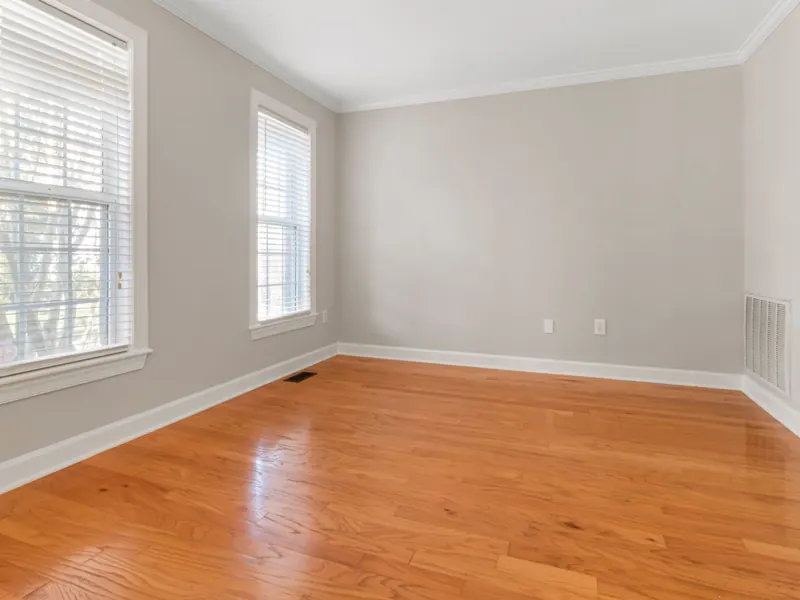
Condos, multi-family homes and rentals
Across the region, the building often matters as much as the wood. In a condo, association rules can limit work hours, elevator use and parking for work vehicles, and many associations ask for a certificate of insurance. In a two- or three-family, it helps to say whether the job is one unit, shared stairs and landings, or both. For rentals, move-out and lease-start dates decide how much time the finish gets to cure before furniture comes back. Put these details in your quote notes, whichever city you’re in.
Older homes add one more step: in buildings from before 1978, painted trim and old vinyl or asphalt tile can contain lead or asbestos, which should be tested before sanding or scraping. The EPA RRP program explains lead-safe work rules.
What’s the same in every city
The basic sequence doesn’t change by ZIP code: prep, sanding, optional stain, finish coats and cure time. Sanding days are noisy, and dust-controlled equipment helps but is not zero dust. The process and timeline page walks through each step, and the FAQ covers common questions such as staying home during the work. If your finish is only dull or lightly scratched, a recoat may be enough; the recoat vs refinish guide explains how to tell.
Not on the list?
If your town isn’t one of the thirteen communities above, ask anyway: enter your town and ZIP on the quote form and you’ll get an honest answer about whether the job can be covered.
Or call (857) 837-1234.
Frequently asked questions
Which Greater Boston communities are covered?
Boston, Cambridge, Somerville, Brookline, Newton, Waltham, Quincy, Framingham, Arlington, Medford, Watertown, Belmont and Needham. Each city has its own page with local notes on housing, typical floors and logistics. Start from the service areas list or go straight to the quote form.
My town isn’t listed. Can I still ask?
Yes. Put your town and ZIP code on the quote form and you’ll get a straight answer about whether the job can be covered. Only the thirteen communities above are listed as service areas today.
Do older city homes need a different approach than suburban homes?
Often. Pre-1940 two- and three-families in Somerville, Cambridge and parts of Boston more often have Douglas fir or pine, previous sandings and painted trim, while mid-century homes in Framingham, Waltham and Newton more often have oak strip under carpet. See the fir and pine guide and recoat vs refinish.
Where do the housing-age figures come from?
From the U.S. Census Bureau’s American Community Survey 2020–2024 5-year estimates, table B25034 (Year Structure Built), via Census Reporter and data.census.gov. They are estimates with margins of error and describe each city as a whole, not any one street.
Can a condo or multi-family unit be refinished?
Usually, yes. Include association rules on work hours, elevators, parking and certificates of insurance, plus whether stairs or landings are shared, in your quote notes. If the floor is engineered, mention it so the wear layer can be checked first.
Photos are licensed stock and Creative Commons images used as examples. Photo credits